The 1966 nickel value depends, as usual, on several factors. The year is common. But the real split is between two formats: the regular strike made for circulation and the Special Mint Set issue made for collectors. They look related, but they do not trade in the same way. Grade matters in both cases. Strike quality matters even more.
That is why this date still gets attention. Most 1966 nickels are ordinary coins. Many are worth little more than face value. Yet some bring clear premiums, and the reasons are easy to follow once the regular strike and the SMS coin are treated as two separate products.
What Is a 1966 Nickel?
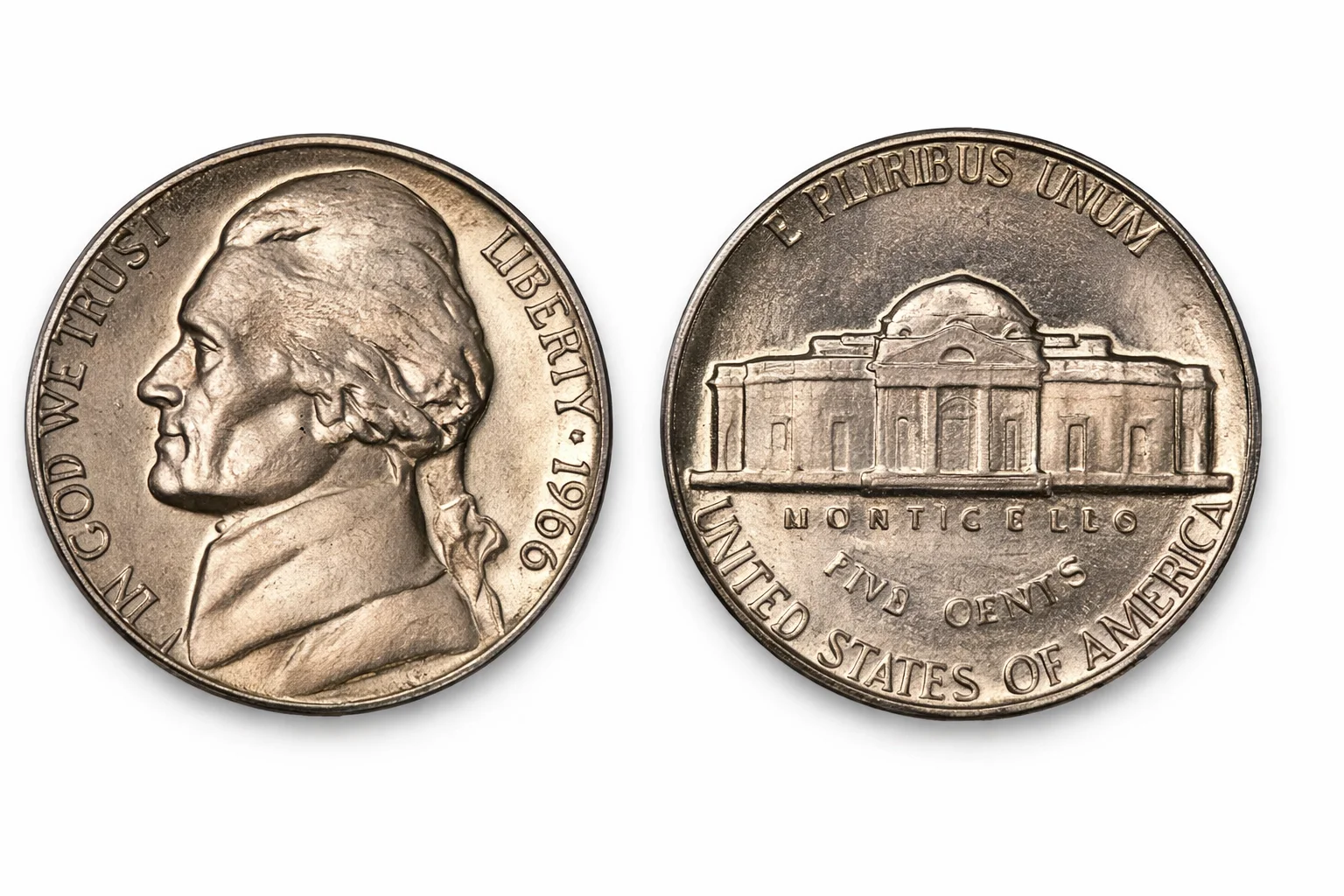
The 1966 Jefferson nickel is a five-cent coin with Felix Schlag’s portrait of Thomas Jefferson on the obverse and Monticello on the reverse. Both the regular strike and the SMS coin share those basic specs. Check them in the table.
| Feature | 1966 Nickel |
| Coin type | Jefferson nickel |
| Designer | Felix Schlag |
| Composition | 75% copper, 25% nickel |
| Weight | 5.00 grams |
| Diameter | 21.20 mm |
| Edge | Plain |
| Mint mark | None of the circulating coins |
| Main formats | Regular strike and SMS |
One detail confuses every year. A 1966 nickel without a mint mark is normal. The U.S. Mint states that the Coinage Act of 1965 removed mint marks from circulating coins from 1965 through 1967. So the missing mint mark does not create rarity by itself.
To know these basics quickly, use the coin scanner app. It can help separate a normal 1966 circulation coin from a better-looking SMS piece before the closer review starts. That does not replace grading. It only makes the first sort cleaner.
Regular Strike: The Common 1966 Nickel
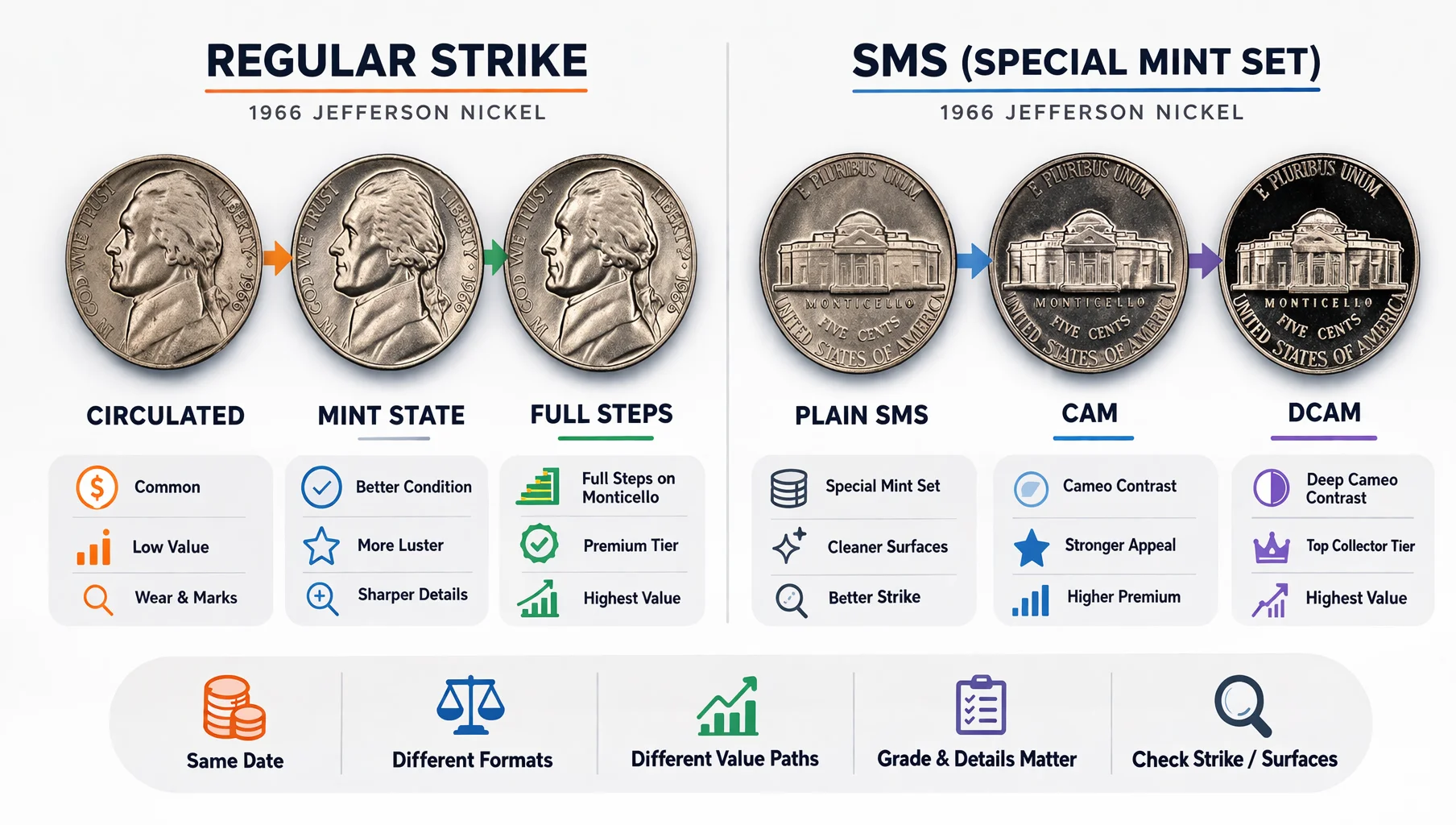
The regular strike is the coin made for everyday use, were issued 156,208,283 pieces. That is a large number. The regular 1966 nickel is common in circulation and common in lower Mint State as well. This is not a key date. It is not a low-mintage issue.
That does not mean all regular strikes are equal. The year is known for generally soft strikes. The 1966 nickel is common even in Gem Mint State, while Full Steps examples are extremely rare and reflect the poor strike quality of the year. That single point changes the whole market structure for the date.
What does a normal, regular strike usually look like?
- Average luster;
- Common contact marks;
- Weak step detail on Monticello;
- Modest value in circulated and lower Mint State grades.
That is why most raw 1966 nickels remain inexpensive. The ordinary pieces are easy to find. The hard part is finding one that is sharply struck and well preserved at the same time.
SMS: A Different 1966 Nickel
The 1966 SMS nickel belongs to a different category. From 1965 through 1968, the Mint did not issue proof sets. Instead, it produced Special Mint Sets, sometimes called Special Strikes. These coins were made on specially prepared planchets. They look better than circulation strikes, but they are not true proofs. PCGS lists the 1966 SMS nickel mintage at 2,260,000.
That difference matters in the market. The SMS coin is not rare in absolute terms, but it starts from a stronger presentation. Surfaces are usually cleaner. The strike is usually more careful. Some pieces show cameo or deep cameo contrast, and those coins follow a much stronger price path than plain SMS pieces. The ordinary 1966 SMS nickels are easy to obtain, while SP68 and higher pieces are much harder, and CAM or DCAM examples are scarcer still.
A quick way to think about SMS:
- Not a circulation strike;
- Not a proof;
- Better-made than a normal business strike;
- More collectible by finish and eye appeal.
That puts SMS into a different lane from the start. A collector should never judge the SMS coin by the same standards used for a worn regular strike from circulation.
1966 Nickel Value Overview
The broad market is easy to read once the two formats are split. A 1966 regular strike in circulated condition is worth about $0.10 to $0.20. Greysheet gives a much wider overall range for the date because top-grade and Full Steps coins sit in the same family. For SMS pieces, the range rises fast as contrast improves.
| Type | Typical lower-range value | Where premiums start | What adds the most |
| Regular strike, circulated | About $0.10–$0.20 | Better Mint State | Strong strike, clean surfaces |
| Regular strike, Mint State | Modest on average | MS66 and up | Scarcity in high-grade |
| Regular strike, Full Steps | Strong premium tier | Immediately | Full Steps designation |
| SMS | About $0.40 and up | Higher SP grades | Better surfaces |
| SMS CAM | Above plain SMS | Mid to high SP grades | Cameo contrast |
| SMS DCAM | Much stronger premium | High-grade certified coins | Deep cameo contrast |
The table shows the core point. The date is common. The real value comes from format, grade, and special designations. A normal, regular strike and a high-end SMS coin do not belong in the same price conversation.
A free coin identifier app also helps at this stage. The Coin ID Scanner app lets a collector check the type, compare the coin with standard examples, and check the value ranges for ordinary and SMS coins.
What Moves the Price Higher?
Grade
Grade is the first driver for both formats. On regular strikes, circulated coins stay low. Lower Mint State pieces stay common. Better-preserved coins start to separate in the upper Mint State range. On SMS pieces, the grade curve rises later, but it rises more clearly once the coin reaches high SP levels.
Strike quality on regular coins
This is where the regular strike becomes interesting. The year is known for weak strikes. That is why many otherwise decent-looking 1966 nickels still fail to attract strong premiums. They may be clean. They may be lustrous. But if the strike is soft, the market treats them as ordinary.
Full Steps
Full Steps is the real dividing line for the regular strike. The Full Steps examples for 1966 are extremely rare. The 1966 Full Steps is from $1,350 to $9,500, while PCGS lists an auction record of $11,750 for an MS65FS coin. That is a very large jump from the level of a normal piece.
Surface quality on SMS coins
The SMS coin depends less on the “can this survive circulation?” question and more on the finish quality. Better surfaces, fewer marks, stronger contrast, and cleaner presentation make the difference here. The 1966 SMS nickels are easy to obtain in ordinary grades, but the better pieces become harder at SP68 and above.
CAM and DCAM
On SMS coins, cameo contrast changes the market sharply. The plain SMS coin has a value range of $0.40 to $100, the CAM coin $5 to $600, and the DCAM coin $140 to $4,500. PCGS shows an auction record of $9,718 for a 1966 SMS DCAM example. That is why collectors do not stop at “SMS or not.” They also ask how strong the contrast is.
Regular Strike Value by Grade
The table below keeps the regular strike side practical.
| Grade level | Regular strike market view |
| Circulated | Usually about $0.10–$0.20 |
| Lower Mint State | Common, modest premium at best |
| MS66 | Better collector interest |
| MS67 | Scarcer, auction-driven examples exist |
| Full Steps | Separate premium market |
This is not a date where every Mint State coin becomes valuable. The regular strike only becomes truly interesting when the condition is far above average or when Full Steps are present. PCGS records the normal regular-strike auction high at $1,150 in MS67. That tells the story well: good coins matter, but Full Steps matter much more.
SMS Value by Grade
The SMS side follows another pattern.
| Grade level | SMS market view |
| Plain SMS | About $0.40–$100 overall |
| Better SP grades | Noticeable premium |
| CAM | Stronger collector interest |
| DCAM | Clear premium tier |
| SP68 and higher | Scarcer, more price pressure |
The ordinary SMS coin is still affordable. The market changes when the coin combines top preservation with stronger contrast. PCGS shows a $712 auction record for a plain 1966 SMS coin in SP68, while DCAM pieces reach a much higher level. That split is the whole point of the SMS market.
How to Check a 1966 Nickel Before You Spend Money
A simple workflow keeps the date easy to handle:
- Confirm whether the coin is a regular strike or an SMS piece.
- Check the surfaces. SMS coins should look sharper and cleaner.
- Review the steps on Monticello.
- Judge the grade honestly.
- Ignore the missing mint mark. It is normal.
- Pay extra attention only if the coin is high-grade, Full Steps, CAM, or DCAM.
That process works because the date is not mysterious. The market is actually very logical. Ordinary coins stay ordinary. Better-made coins do better. Special designations do the rest.
Final Verdict: Regular Strike or SMS?
The regular strike is the common coin. The SMS coin is the collector format. Both are real 1966 nickels, but they belong to different value lanes. Regular strikes depend on grade and, above all, Full Steps. SMS coins depend on finish, grade, and cameo contrast.
That is the practical answer to the 1966 nickel value. The date alone does not carry the premium. Condition does. Strike does. Format does. For most pieces, the coin is modest. For the best ones, the difference between regular strike and SMS is where the real market begins.